






Updated for the 2025 law change effective January 1, 2026
Quick Summary
Starting in 2026, employers may qualify for a much larger federal tax credit when they help pay for child care for their employees. If your business offers backup care, covers nanny services, or partners with a daycare provider, this could mean real savings at tax time.
Here’s what’s changing, how it works, and what to know if you’re an HR professional or small business owner thinking about offering child care benefits.
What Is the Employer-Provided Child Care Credit?
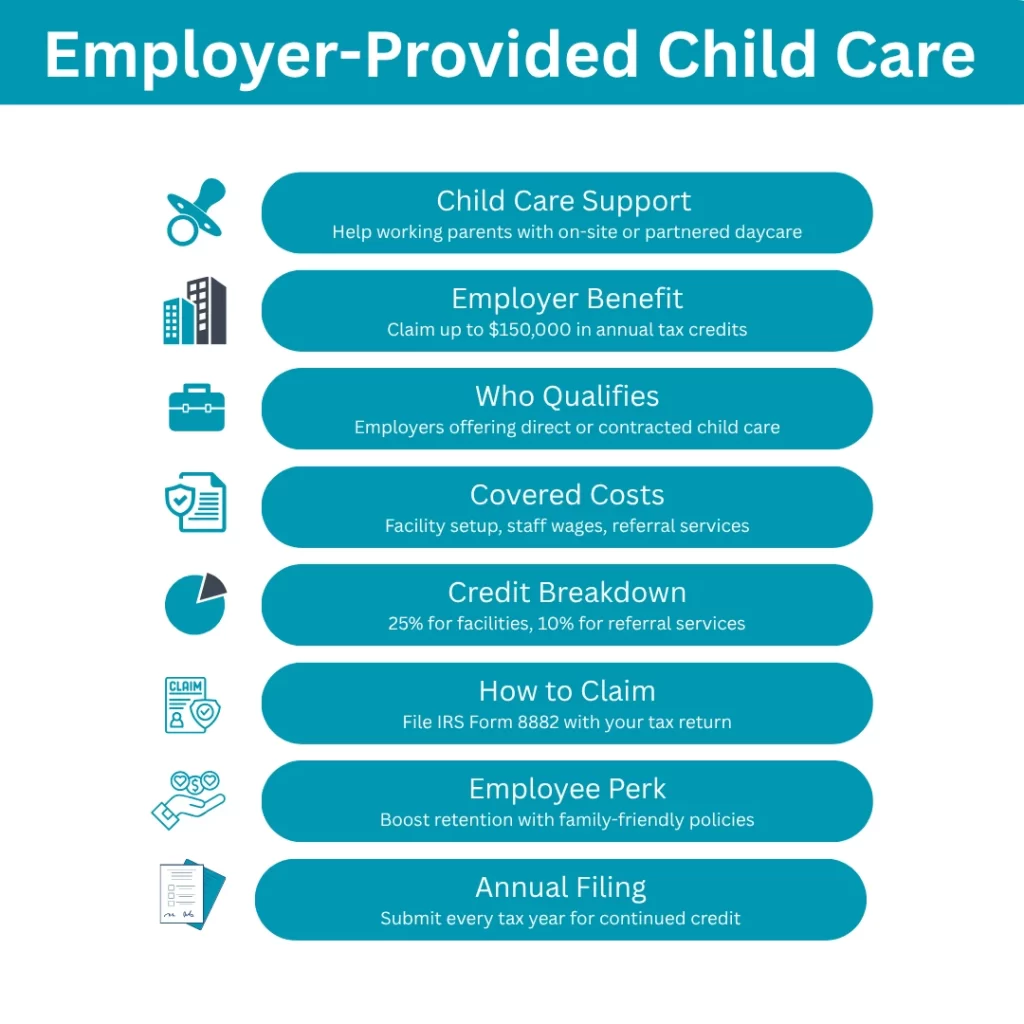
The Employer-Provided Child Care Credit (Internal Revenue Code §45F) is a federal tax credit businesses can claim when they help cover child care for their employees.
This could include:
- Paying a licensed child-care facility directly
- Contracting with a third-party backup-care or nanny agency
- Offering in-home nanny placements for employees
- Providing child-care resource and referral services
The goal? Encourage employers to support working parents—and help offset the cost of doing so.
What Changed in 2025?
Thanks to the July 4, 2025 federal bill (nicknamed the “One Big Beautiful Bill”), the child care credit got a big upgrade starting in tax year 2026:
Before |
Starting in 2026 |
|---|---|
|
25% credit rate |
40% credit rate (or 50% for small businesses) |
|
$150,000 annual credit limit |
$500,000 limit (or $600,000 for small businesses) |
|
Limited to direct payments to facilities |
Now includes payments to agencies or “intermediate entities” |
Who Might Be Eligible?
Your business may be eligible for this credit if you:
- Pay a licensed daycare or preschool to reserve slots for employees
- Contract with an agency (like Hānai) to provide backup care or in-home nanny services
- Offer child care as a formal employee benefit, with proper documentation
You don’t have to run your own daycare center. Many businesses outsource the care and can still qualify.
⚠️ Important: You’ll need to make sure your provider meets state or local licensing requirements. If you work with a third-party agency, that agency must contract with licensed child-care providers.
What Counts as a “Qualified Child Care Expense”?
Under the new law, qualified expenses could include:
- Payments to licensed child-care facilities (e.g. preschools, daycares)
- Payments to agencies (intermediate entities) that coordinate child care with licensed providers
- Costs for child-care referral services
If you’re working with a backup-care agency that sends nannies into employees’ homes, and that agency uses licensed or properly credentialed staff, those payments may qualify for the credit.
How the Credit Works (Step-by-Step)
- Set up your child care benefit
Contract with a licensed facility or backup-care agency to provide care services for your employees. - Track your spending
Keep records of what you pay to each provider or agency throughout the year. - File Form 8882 with your federal business tax return
This form calculates your 40% (or 50%) credit based on total qualified expenses. - Reduce your tax bill
The credit directly lowers the amount of tax your business owes.
What About Small Businesses and S-Corps?
Small businesses may qualify for the higher 50% credit rate and $600,000 cap if their gross receipts fall below the IRS threshold (around $31M as of 2026).
One-owner S-corporations can still claim the credit on company-paid care costs. But owners cannot use a Dependent Care FSA to exclude reimbursements from their own taxable income (IRS rules treat them differently from C-corp owner-employees).
Can I Combine This With a Dependent Care FSA?
Yes! These two benefits can work together:
- Dependent Care FSA (IRC §129) lets employees set aside up to $7,500/year pre-tax for child care.
- The IRC §45F credit goes to you—the employer—when your business pays for care or contracts with a provider.
Employees use the FSA to save on taxes. You use §45F to save as a business.
Things to Keep in Mind
- Keep documentation: You’ll need contracts, invoices, and proof of provider licensing.
- Use it for backup care, not full-time daycare: Daily usage that looks like regular child care could disqualify the benefit.
- Offer fairly: Don’t limit this benefit only to executives—IRS nondiscrimination rules apply.
- Get professional advice: Every business structure is different. A CPA can help you apply these rules correctly.
Final Note
This article is for informational purposes only and reflects changes known as of July 2025. Tax laws and IRS guidance can change. Please consult a qualified accountant or tax advisor to determine how this applies to your business.
Want to learn more?
You can find the full text of the updated law in Public Law 119-21, and review official credit details in IRC §45F and IRS Form 8882 instructions.
If you’re looking for child care providers who can support your team—backup care, in-home nannies, or resource & referral services—look for agencies familiar with the updated tax credit requirements.